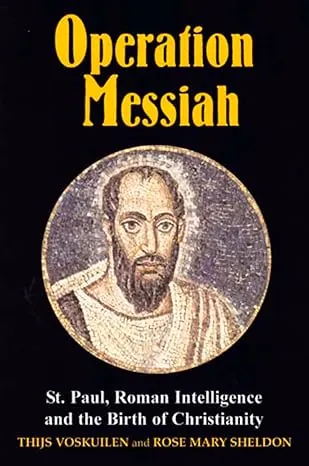

Every scholarly reconstruction of Paul begins with the same cast: Jerusalem elites, Pharisaic debates, emerging Christian communities, and Rome as a distant administrative backdrop. The analysis unfolds as if the eastern Mediterranean were a closed theological system.
But Paul didn't operate in a theological vacuum. He moved through an active Cold War zone.
While scholars debate Paul's conversion experience and his letters' theological content, they consistently overlook the empire that defined Rome's eastern strategy throughout his lifetime: Parthia, or Persia. This wasn't a minor regional power. Parthia had humiliated Roman legions, controlled the Euphrates frontier, and hosted the largest Jewish populations outside Roman jurisdiction — communities beyond imperial oversight, capable of independent action, and positioned along the empire's most volatile border.
Roman security policy toward Judea, the diaspora, and messianic movements cannot be understood without Parthia in the frame. Yet standard Pauline scholarship proceeds as if Rome faced no eastern rival, as if Jewish diaspora communities existed in geopolitical isolation, as if Paul's mission unfolded in a strategic vacuum.
This analysis restores Parthia to the picture — and asks what changes when Paul's behavior is examined against that geopolitical context.
In counterintelligence methodology, stated motivations are tested against strategic alignment. When an individual's movements, timing, messaging, and network access consistently serve state interests while claiming purely personal or religious motives, that pattern demands systematic assessment.
The analysis that follows applies Structured Analytic Techniques from professional intelligence analysis to the Paul case.
Suspicions about Paul's credibility aren't new. They surfaced in his own lifetime — voiced by Jerusalem leadership, documented in his own defensive rhetoric, visible in the conflicts that shadow his letters. Those ancient doubts have echoed through modern scholarship without ever receiving systematic counterintelligence assessment.
But before examining the theological content of this defector's message, counterintelligence methodology requires a prior question: Can this defector be trusted?
That assessment comes first. The theological analysis follows only after vetting the source.